
Monday, October 12Monday, October 12Conflict & Communication
Highly Escalated Conversations: An On-Demand Course for Couples
A step-by-step structure for the topics you can't talk about, with Julie Menanno, LMFT
Some conversations run you instead of you running them. Money, chores, parenting, in-laws, something from the past. This course gives you and your partner a clear structure for the topics that always blow up, so you both get heard, the old hurts get repaired, and the problem finally gets solved.
7 chapters · 51 lessons · over 2.5 hours of video · 6 printable exercises · watch anytime, yours to keep
$149 one time. Lifetime access. Secure Love Club members save 25 percent.
Launch offer: $50 off through Monday, October 12. The discount is applied automatically at checkout.
“The goal is not to never get escalated again. The goal is to know what to do when you do.”
Julie Menanno
Secure Love
NATIONAL BESTSELLER
1.5M+
FOLLOWERS
1M+
PODCAST DOWNLOADS
What is a highly escalated conversation?
A highly escalated conversation is one where your emotional activation gets so high that you lose the ability to communicate with the flexibility you normally have. You interrupt, talk over each other, get louder, get defensive, bring in five other problems, or correct every detail. Or you go quiet and shut down. Escalation isn’t always loud. The defining feature is that the conversation starts running you instead of the two of you running the conversation.
You don’t have to fight all the time for this to be you. Some couples are escalated across their whole relationship. Others communicate well and enjoy each other, and still have one or two topics they cannot talk about without getting pulled into the same painful place.
This course is taught by Julie Menanno, LMFT, LCPC, a licensed marriage and family therapist and author of the Simon and Schuster bestseller Secure Love. It is grounded in attachment theory and Emotionally Focused Therapy, the same frameworks she uses with couples every day.
Inside the course
Seven chapters, 51 lessons, over 2.5 hours of video
Short lessons you can take one at a time. Here is everything in the course, chapter by chapter.
-
Before You Begin: A Note from Julie
A short welcome from Julie on how to move through the course without overwhelming yourself or each other.
-
Chapter 1: Why the Same Fight Keeps Taking Over
-
Is This Course for You? What "Highly Escalated" Really Means
Julie introduces the course and defines a highly escalated conversation, which is not always a loud one.
-
Why You Both Fight to Be Understood and Nobody Gets Heard
What happens in your nervous system when a conversation heats up, and why two people fighting to be heard means no one is listening.
-
Why You Can't Use the Skills You Already Have
You know how to listen and validate. This lesson explains why that knowledge disappears in the moments you need it most.
-
How Structure Calms a Heated Conversation
How giving each partner one clear job, and separating the kinds of conversations you’re having, changes everything.
-
You Won't Need the Structure Forever
Why the structure is a way to build trust, and how conversations loosen up as that trust grows.
-
Which Conversations Need Structure
How to spot the topics where you lose each other, and when to decide to use the structure.
-
Before Exercise 1: Learning to Spot Your Activation
Julie sets up the first exercise and explains how to choose the right topic to practice with.
-
Exercise 1: Know What Happens to You When You Get Activated
A guided, pause-as-you-go exercise that maps what activation looks like in your body, your attention, and your behavior.
-
-
Chapter 2: The Three Conversations: Connection, Repair, Solution
-
What Conversation Are We Actually Having?
The first step in creating structure: figuring out which of three conversations you're trying to have.
-
Connection, Repair, Solution: What Each One Is For
A plain definition of each conversation and the different goal each one has.
-
Reflection: Which Conversation Were You Trying to Have?
A short reflection on your last difficult conversation, and whether you and your partner were even in the same one.
-
Connection Comes First
The most important idea in the course, and why solutions and apologies don't land without it.
-
When You Need a Repair Conversation
How to tell the difference between a disagreement and an injury that needs its own conversation.
-
When You're Ready for a Solution Conversation
Why solving the problem is the conversation everyone rushes to, and the question to ask before you start.
-
Your Conversation Map
The simple map that tells you which conversations your issue needs and in what order.
-
A Quick Note Before the Exercise
A brief note on where you are in the course and what comes next.
-
Exercise 2: Map One of Your Difficult Conversations
A guided exercise that maps one recurring conflict onto the three conversations.
-
-
Chapter 3: The Connection Conversation: Feeling Understood Before Anything Else
-
The Sharer and the Receiver
The two roles in a connection conversation and the one job each of them has.
-
Validation: "It Makes Sense That You Feel That Way"
What validation is, what it is not, and why it has to come before reassurance.
-
Reassurance: Helping Your Partner Feel Less Alone
How to answer the fear underneath what your partner is telling you, and how to know if they need it.
-
The Sharer's Job: From Complaint to What's Happening Inside You
How to share your experience in a way your partner can take in, instead of building a case against them.
-
The Receiver's Job: Staying Curious When You Disagree
What to do with the urge to defend yourself, and the questions that help you understand instead.
-
Switching Roles: Making Room for Two Experiences
How to know when it's time to switch, and how to hold two different versions of the same event.
-
Exercise 3: The Full Connection Conversation
A guided practice of the whole connection conversation, step by step, with both partners taking each role.
-
-
Chapter 4: The Repair Conversation: Healing What Still Hurts
-
When Something Between You Needs Repair
When a repair conversation is needed, the two roles in it, and why you work with one injury at a time.
-
The Hurt Partner's Job: Sharing the Impact
How to tell your partner what their actions did to you without arguing about what they intended.
-
The Repairing Partner's Job: Impact Before Intention
Why understanding the impact comes before explaining yourself, and how both impact and intention can be true.
-
Taking Responsibility Without Sinking Into Shame
How to own your part without collapsing, defending, or leaving your partner to take care of you.
-
Why "I'm Sorry" Isn't the Whole Repair
The six pieces of a complete repair, and why an apology on its own often leaves your partner still hurting.
-
When an Apology Doesn't Land
What to do when you've apologized and your partner is still hurt, for both sides of that stuck place.
-
Rebuilding Trust: Reassurance and Changed Behavior
How trust is rebuilt after an injury, through words that answer the fear and behavior that gives new evidence.
-
Exercise 4: The Full Repair Conversation
A guided, nine-step practice of the full repair conversation on one injury.
-
-
Chapter 5: The Solution Conversation: Solving the Problem as a Team
-
Are You Ready to Solve the Problem?
Three questions to ask before you try to solve anything, and what to do if the answer is not yet.
-
Define the One Problem You're Solving
How to turn a complaint or a judgment into one specific problem you can make a plan around.
-
What Matters to Each of You, and Why
Why couples get stuck arguing over positions, and how to find what each of you needs underneath.
-
Take Turns Before You Negotiate
How to hear what each partner needs from the solution before anyone starts bargaining.
-
How This Differs From the Connection Conversation
You already took turns understanding each other. Here is what's different this time.
-
What's Essential and Where You Can Bend
How to sort what you want into what matters most and where you have room to give.
-
Building the Solution Together
How to generate options, choose one, and make the agreement specific enough to hold.
-
Treat the Solution as an Experiment
How to take the pressure off any agreement by setting a trial period and a check-in date.
-
Exercise 5: The Full Solution Conversation
A guided, seven-step practice of the full solution conversation on one real problem.
-
-
Chapter 6: When It Gets Too Heated: How to Pause and Come Back
-
Knowing When to Stop Talking
The signs that continuing will make things worse, and why catching them early matters.
-
How to Call a Pause Without Abandoning Your Partner
The three things to say when you need a break, and the job of the partner who wants to keep talking.
-
What to Do During the Break
How to use a break to regulate, not to rehearse round two.
-
How to Come Back to the Conversation
How to re-enter after a break, and the difference between postponing and avoiding.
-
Exercise 6: Create Your Pause-and-Return Plan
A short exercise to build your plan for breaks, including the phrase you'll both use to call one.
-
-
Chapter 7: Putting It All Together: One Couple, Start to Finish
-
Meet Sarah and Michael: The Chores Fight
An example couple who keeps fighting about household responsibilities, and the question that changes where the conversation goes.
-
Their Connection Conversation
Julie walks through Sarah and Michael taking turns as sharer and receiver, and what is underneath the fight about chores.
-
Their Repair Conversation
One hurtful comment from an old fight gets its own repair, with one injury handled at a time.
-
Their Solution Conversation
With connection and repair done, Sarah and Michael build a specific plan and agree to test it.
-
What to Do the Next Time You Get Escalated
Julie closes the course with what to expect as you practice, and what to come back to when it gets hard.
-
Keep Going: What Comes After This Course
Where to go from here, plus a quick way to tell us how the course worked for you.
-
The pattern
You know how to communicate. You just can’t get to it.
You know you’re supposed to listen. You know interrupting doesn’t help. You can probably talk about this exact issue calmly on a good day, see your partner’s side, even own your part.
Then the topic comes up and your nervous system goes into protection. Everything turns black and white. You both become focused on one thing….. getting the other person to understand you. And when you’re both fighting to be heard at the same time, nobody is listening.
Not because you’re doing something wrong. Not because either of you is broken.
You don’t need to be told to communicate better. You need a STRUCTURE that lets you reach the skills you already have when it’s hardest to reach them. One job at a time. One person at a time. And a turn you don’t have to fight for.
The structure
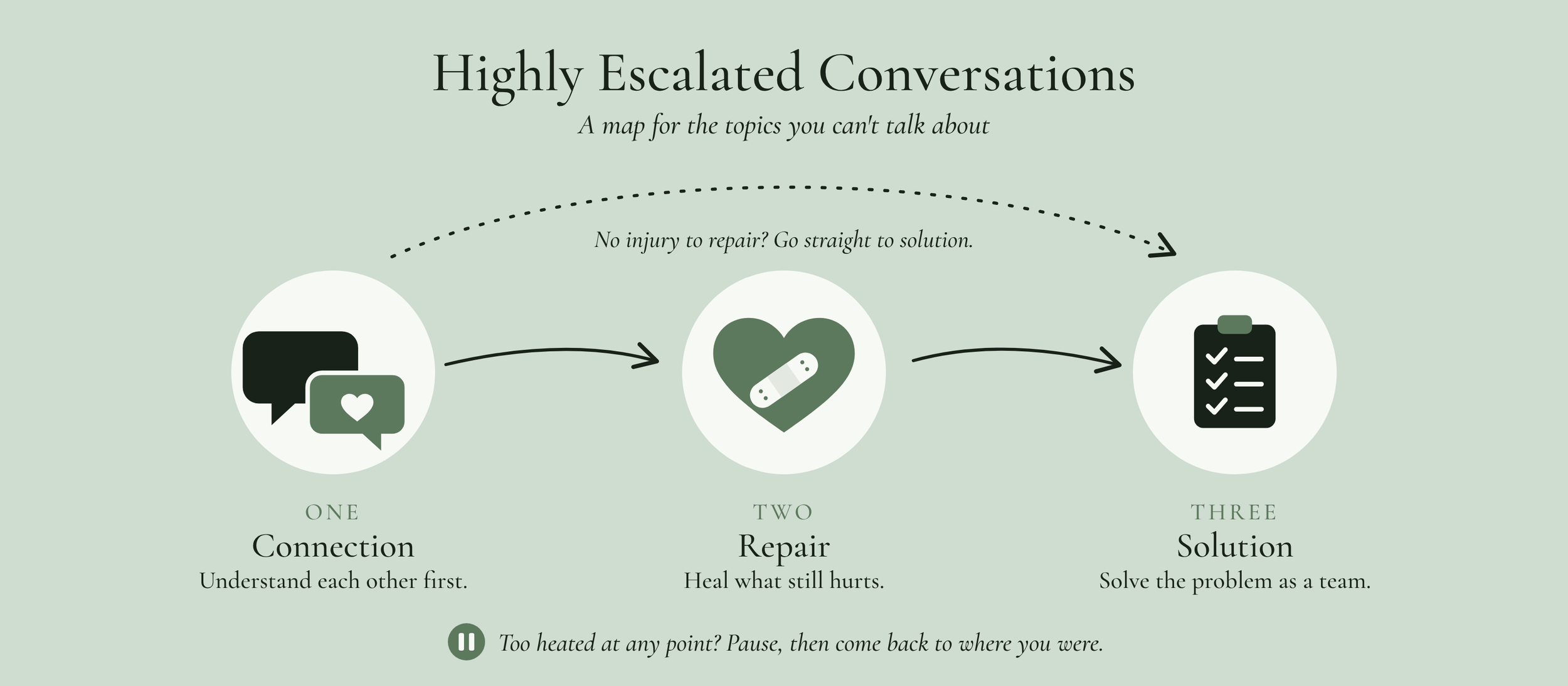
Three conversations, in order
Highly escalated couples get into trouble because they try to feel understood, heal an old hurt, and solve the problem all at once. This course takes them apart.
Connection
Do you understand my experience? Do I understand yours? One of you shares, the other validates and reassures, and then you switch. Connection always comes first.
Repair
For when something happened between you that still hurts. One injury at a time, with a clear job for the hurt partner and the repairing partner.
Solution
What are we actually going to do about this? One defined problem, what matters to each of you, and a plan you both agree to try.
What changes
What you will walk away understanding
Why you lose each other
What happens in your nervous system when a topic heats up, and why the skills you already have go offline.
Which conversation you’re in
Connection, repair, or solution. Most stuck couples are trying to have all three at once.
How to feel understood
A sharer and a receiver, one job each, and a protected turn so nobody has to fight for the floor.
How to repair what still hurts
Why “I’m sorry” is only one piece, and what the rest of a repair needs.
How to solve the actual problem
One defined problem, what matters to each of you, and a plan you treat as an experiment.
What to actually say
Words, not principles. Julie scripts both sides of every conversation, and walks one example couple through all three.
Free lesson
Watch the first lesson before you buy
In the opening lesson, Julie explains what “highly escalated” really means and who this course is for. If you recognize your own conversations in the first two minutes, the rest of the course was built for you.
The part people will talk about
One couple, one fight, all three conversations
Sarah says, “I shouldn’t have to keep asking you for help. You live here, too.” Michael says, “I do help. You just don’t notice anything I do.” And they’re off.
In the last chapter Julie shows what happens when this example couple stops and asks which conversation they need first. She walks through every line, so you can hear what the structure sounds like out loud before you try it yourselves.
Chapter Seven. Five lessons, sixteen minutes.
Who it’s for
Who this course is for
Whether you take it together or on your own, the material meets you where you are.
This course is for you if:
almost anything can turn into a fight
you do well most of the time, until one topic comes up
you’ve argued about money, chores, parenting, in-laws or physical intimacy for years and nothing shifts
you interrupt, talk over each other, or bring in five other problems
one or both of you goes quiet, shuts down, or walks away
apologies don’t seem to land
you agree on a solution and it falls apart a week later
You do not need to be in crisis to take this. Plenty of couples who need it are doing fine everywhere else.
Your teacher
Why learn from Julie Menanno
LMFT, LCPC · Author of Secure Love
Julie is a licensed marriage and family therapist, a licensed clinical professional counselor, and the founder of The Secure Relationship, a global coaching practice rooted in attachment theory and Emotionally Focused Therapy. She has built an audience of more than a million people by turning complicated relationship dynamics into something you can recognize in your own kitchen. She hosts The Secure Love Podcast.
This course is the structure she gives the couples who come to her unable to get through a hard conversation.

What you get
Included with your purchase
51 video lessons across 7 chapters, over 2.5 hours of video
6 printable exercise PDFs, one for each conversation plus your pause-and-return plan
Word-for-word scripts for both partners in every role
A full worked example: one couple, one fight, all three conversations
Lifetime access. Watch it as many times as you want
One purchase covers two people watching together
Pricing
One price, yours to keep
$149
One time, or two payments of $79. The full course, the six exercises, and the worked example.
No subscription, no expiry date.
Launch offer: $50 off through Monday, October 12. The discount is applied automatically at checkout, so there is no code to enter.
Secure Love Club members: $111.75
Members save 25 percent. Apply it with a member-only discount code at checkout.
A step-by-step structure for the conversations that always blow up.
Questions
Frequently asked questions
-
It’s a conversation where your emotional activation gets so high that you lose the flexibility you normally have. You interrupt, defend, repeat yourself, or shut down. It isn’t always loud. The defining feature is that the conversation starts running you instead of you running it.
-
No. Some couples escalate about almost anything. Many others do well until one topic comes up. The course is built for both, and for any couple who knows certain conversations need more structure.
-
The videos run just over 2.5 hours across 51 short lessons. The six exercises take additional time, and they work best spread out. A chapter a week is a comfortable pace.
-
No. Julie speaks to people doing it alone and to couples doing it together. The exercises have you answer separately first either way. The practice conversations in Chapters 3 to 5 do need both of you.
-
Yes. One purchase covers two people watching together.
-
The Negative Cycle series helps you see and understand the pattern you get pulled into. This course gives you the step-by-step structure for the next hard conversation, with a script for each role. They work well together, and you don’t need one to take the other.
-
No. This is education, not treatment. It is not a substitute for working with a licensed professional.
-
This course is for couples who get stuck in painful conversations. It is not designed for relationships where there is violence or where one partner is afraid of the other. If that is your situation, please reach out to a licensed professional or a local support service.
-
For good. There is no expiry date.
-
Yes. All six exercise PDFs are included and can be printed.
-
$149 one time, or two payments of $79. Secure Love Club members save 25 percent.
-
No. Julie explains everything in plain language and there is no required reading.
Start today
You can talk about the things you can’t talk about
Not because the hard topics disappear, but because you finally know which conversation you’re in, whose turn it is, and what to say next.
Keep going
Related on The Secure Relationship
Negative Cycle Workshop Series · The Sex Cycle · Relationship Repair · Communication in Relationships · Work With a Coach
Not sure where to start? Take the free Attachment Style Quiz to see your side of the pattern.